Cult Television: 101 Forgotten Shows to Remember
Cult Television: 101 Forgotten Shows to Remember by Doug Brode, Published: 2026
We’ve noted in these pages before that Doug Brode is one of the, if not THE, most knowledgeable people about TV and film who’s currently writing about such subjects. 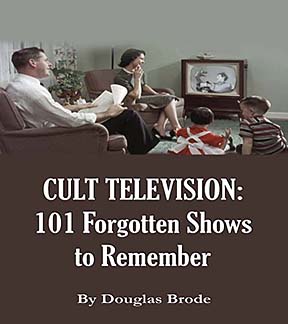 Some years ago, on a local TV show, the on-camera team played a game called “Stump Doug,” in which they asked him a question about the subject, and he had to respond – live, on camera, no preparation. The game was opened up to viewers, and together everyone tried to “stump Doug.” Nobody succeeded.
This book proves that he knows his subject.
Sure, these days, anyone could come up with a list of one-season-tv-shows, or famous names that once created a TV show, or strange and unusual ideas for a series. But as he unrolls the list, and provides the time, place, action, reception and demise, he clearly saw the majority of these shows, at least at some point, and formed a personal take on them.
From Doug Brode, at his current home in San Antonio: “Initially I had the idea to do a book entirely on Forgotten Shows of the 1950s. Then, I would get to work on the Sixties, and so on and so on…Then, it occurred to me. A book on 1950s television would primarily appeal to Boomers, like me. And, sad to say, there aren’t all that many of us left anymore. But if I were to include ‘lost’ shows beginning in 1948 and continue on to the early 21st Century, there might well be something here for everybody. Which would allow the volume to appeal to a much broader, wider audience. That meant dropping a lot of wonderful shows I grew up watching. But I’ll simply include them in a follow-up book, which I’m already working on.“
Aside from the sheer number – 101 – one observation that amazed and amused was the number of big-name actors, producers, writers, and even music writers who showed up on the list of these gone-but-not-forgotten shows. Of course, it may have been early-career action for many of those named – but it’s still rather amazing to discover that Steven Spielberg and John Williams (music track creator par excellence) were once writing for weekly tv shows!
Brode starts the book by reminding us that while TV really began to take off in the late 50s and early 60s, hitting its stride in the 70s, it had been around for some time before that, though not available to the “average Joe.” Many of those very early shows were done live, so live in memory only, but later, with the advance in videotape, shows were preserved for later audiences to enjoy. And based on the success of reruns and classic viewing, people still enjoy the “primitive” efforts of early TV pioneers.
The shows in this volume are listed alphabetically, making access to known shows simple, and in a way, encouraging the reader to plow through the entire book, rather than picking out a year or two and missing entirely the many surprises it has in store. They range in date from the late 40s to more or less the present time, and cover everything from series to specials to hits to misses.
Brode: “The book expresses my adoration of the television medium, yet I sensed the importance of respecting a potential reader’s agenda as well. For instance: I’ve always been a fan of Westerns on television or at the Movies. But I am aware that not everyone feels that way. So it was important to me that I keep the number of ‘Oaters,’ as they were once called, to a minimum so that the book wouldn’t suffer from Tunnel vision. Of course, Gunsmoke, Bonanza and a few oaters are well remembered. They continue to run on cable channels to this day and are easily available for Streaming. So there was no thought of including them. But two of my personal favorites from 1960 were ‘The Westerner’ and ‘Hotel de Paree.’ The former was on NBC and featured Brian Keith as a notably non-heroic cowboy. Brown, aka ‘Spike,’ that big lovable dog from Old Yeller tagged along behind him. This was Sam Peckinpah’s dream series, but the public wasn’t ready for such a de-glamorized vision of the West and it only lasted thirteen episodes. More or less simultaneously, I over on CBS, and also on Friday evenings, actor Earl Holliman played the Sundance Kid a decade before Robert Redford immortalized him on film. In “Hotel de Paris,” Sundance wasn’t the great shot everyone believed him to be. On his hat there was a band of silver buckles all the way around. When an enemy went for his gun, Sundance would turn and twist his head so that the sunlight blinded the opponent. Then The Kid simply shot the man dead. Not precisely like fair and square Hugh O’Brian on The Life and Legend of Wyatt Earp. That ABC show, which played to a mainstream audience’s expectations, lasted for six seasons. Hotel? One. Which rates it as a cult show. Anyway! I wanted to include both. But I forced myself to choose just one. So The Westerner is included. Sundance will have to wait for the follow up book.”
Within a few pages we find a series, aired from 1985-1987, called “Amazing Stories,” a series hoping to intrigue the same audience that made (and still makes) “The Twilight Zone” so popular. “Amazing Stories” was the brainchild of Steven Spielberg, along with Kathleen Kennedy (yes, that Kathleen Kennedy), Frank Marshall, Danny Elfman and John Williams. The anthology of “amazing stories” ranged from horror to humor, and offered viewers actors like Clint Eastwood, Patrick Swayze and Charlie Sheen, and writers like Richard Matheson (“I Am Legend”) and Jack Finney (“Time and Again”), both writers reviewed in this column. Why it didn’t run for more than 30 episodes defies logic, and at least this TV fan. Check out Apple TV or Prime to watch a few of them!
Brode: “It seemed so important to me that I include the widest variety of types of series that was possible. Moreover, I wanted to explore the pioneer days of television. So I include the earliest game show, soap opera, sports broadcasting, news show, police series, science-fiction/fantasy. And I love to share fond memories of those series that flopped. Does anyone still living other than me recall Vincent Price hosting a game show called E.S.P., in which contestants sought to outdo one another as to extraordinary sensory perception, live each week. And the unintended humor came in the realization that none of them possessed any gifts at all.”
Some of the series Brode recovers for our memory recall times, places and events. Like “An American Family,” an early PBS documentary offering that had the cameras trained on a “typical” family as the father’s “business would fail,… (his wife) would discover (he) was involved with another woman, or that both must deal with one of their sons ‘coming out of the closet.’”
We wonder along with Brode how this series failed as he examines a police-procedural/courtroom drama series like “Arrest and Trial (‘63-’64) that watched a case develop from an investigation and arrest to the courtroom, and featured such stars as Chuck Connors, Ben Gazzara, Roddy McDowell, James MacArthur, James Whitmore, Robert Duvall (and that’s only a partial list!).
Maybe you remember “Corky and White Shadow,” an early girl-led, Disney-princess adventure series; or you’ve heard of “Crusader Rabbit, an animation series that ran 7 years in the 50s and was still used as an in-the-know rib for someone acting noble (and or goofy) years later.

Brode: “When I was young I loved reviewing movies and television for newspapers (anyone remember them?) and on the radio and TV. Hard to believe, but that was half a century ago. Now, in my twilight years, I find that the vast majority of what there was to be consumed no longer speaks to me. Not that there’s anything wrong with them, mind you. Only that by and large they ‘speak’ to today’s young audience. How nostalgic it is to go back in time and keep the legends alive. There are already several books out there by other authors on The Greatest TV Shows of all-time. Terrific. That’s been done and done well. But there are those once beloved, now all but forgotten shows that for a brief period of time delighted us, then disappeared, often without a trace. Here is my attempt to give them their due. Golden Memories for those who, like me, delight in keeping scrapbooks from the good old days.”
Depending upon the show he’s highlighting, Brode brings in elements of style, culture, history, and even political slant, drawn from his unique perspective as a film critic, writer, viewer, and culture watcher. Telling us that “Dr. Fu Manchu, aka The Adventures of Dr. Fu Manchu” ran in 1956 and who starred is fine, but adding some background on villains, particularly Oriental, evil genius villains portrayed by Anglo actors, adds something so much more intriguing to the simple display of a list.
Brode goes on to catalogue, as promised, 101 TV moments, from “then” til “now,” filled with nostalgia, surprise, amusement and promises to “find that one and watch it now that I’ve learned about it.” And as with most of Brode’s insights regarding film and TV, you won’t watch it the same way again now that you’ve read his takes.
Doug’s Upcoming Books:
• MISTLETOE MOVES: The Iconic Holiday Films –Due out on Nov 1
• The Second time Around: Contemporary Remakes of Disney Classics
• From Lucas to Disney (the impact that the sale of Star Wars from Lucasfilms to Buena Vista has had for better or worse)
• Star Wars at 50: A Retrospective
• Stephen King: From Print to Film
• CinbeFantastique: The Iconic Fantasy films
And he is working on a novel about Jack the Ripper: DOPPELGANGER, or Once Upon a Time in Whitechapel