Cool, Crisp Ciders of Fall
Apple season is upon us! Lucky for us, we live in the heart of apple country and just beyond our small region, the rest of the Northeast also produces massive amounts of apples that are transported throughout the rest of the country, for both consumers and cideries alike.
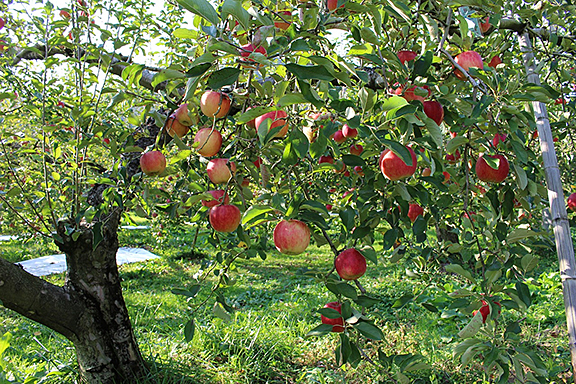 Most everyone who went to grade school in the United States has heard of Johnny Appleseed, (or John Chapman, which was his real name), but did you know that those famous seedlings of his during the late 1700s and into the early 1800s weren’t planted for the intention of eating, but instead planted with the intention of creating hard cider? You see, water was not exactly the drink of choice in America during our early years as it wasn’t always safe to drink, especially as settlers traversed the frontier to settle lands west of Pennsylvania. Hard cider, because it underwent fermentation that killed harmful bacteria, was a much safer and more sanitary alternative and deemed an appropriate beverage for the whole family to consume.
While truly any variety of apple can be utilized, most hard ciders are ranked from sweet to dry, just like wine. Therefore, different varieties of apples will yield different results along the scale. Apples have acids and tannins, just like grapes, which also contribute to the specific end product that is created.
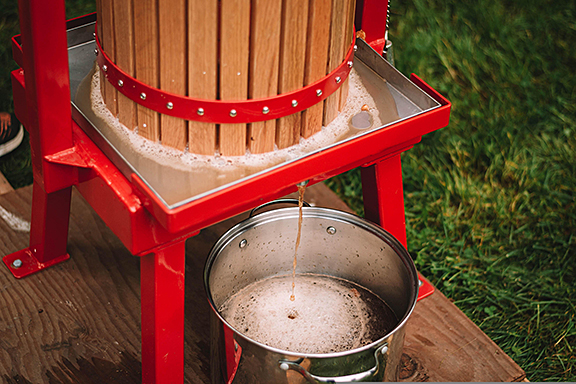
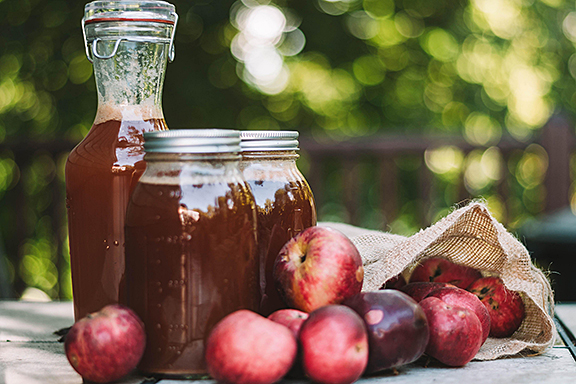
Apples are harvested when ripe and pressed for the juices. The fresh juice is then collected and placed into tanks, casks, vats, barrels, etc., where simple sugars in the apple juice are converted into ethanol by yeast; these yeast strains can be wild, but today’s ciders typically contain cultivated strains that are added by manufacturers. Temperatures at which ciders are created vary anywhere from 60-75 degrees Fahrenheit. Eventually, the yeast is filtered out, and the liquid is strained and placed into a new container. Fermentation continues as it sits and carbon dioxide is created with the remaining sugars, thereby creating carbonation. As well, other flavors, juices and additives can be added during this process of fermentation as well; it is not unusual to find hopped ciders, ciders with additions of honey, cranberries, grapes and even maple syrup! Fermentation can take anywhere from 3 months to 3 years. Most cideries also pasteurize their product which not only kills any possible remaining bacteria, but also halts the fermentation process and allows for longer stability and shelf-life in a can or bottle.
Recently, my cousin and her husband hosted a Friday game night inviting our closest (and most fun!) family members. I opted to bring a few cans of cider to our gathering for everyone to sample while they provided me with their feedback; everyone in our little group loves to toss a few back when we get together, so the free booze was immediately welcomed. We started from the lightest and most unobtrusive ciders and worked our way along the spectrum to finish with cider that almost didn’t even resemble a cider!
Crisp Apple, Angry Orchard, Walden, NY. 5% ABV. – This is your standard, basic hard apple cider, which also happened to be the second most favorite out of the 9 of us who were partaking. Even better, this is a very popular mass-produced hard cider that you can find almost everywhere alcohol is sold. Round-table tasting notes: “mild,” “semi-sweet,” “crisp,” “juicy & refreshing,” “tastes more like apple juice – can’t taste the alcohol,” “nicely carbonated,” “palatable – would be good with a nice sharp cheddar.” (P.S. did you know Angry Orchard, located on 60-acres in the Hudson Valley, gives tastings and tours? Certainly, somewhere to check out next time you’re headed downstate.)
Pearsecco, Wicked Grove, private-label brand exclusive to Aldi, 5% ABV. – The first of the fruited ciders we sampled, it is definitely a cross between a traditional cider and Prosecco, an Italian sparkling white wine. Round-table tasting notes: “very effervescent and bubbly,” “dry,” “light,” “mild,” “a hint of pear,” “it’s like a seltzer.” Most of us found that it could have been a bit more flavorful. (Fun fact: Woodchuck Cidery located in Middlebury, Vermont is said to be one of the contract cideries brewing Wicked Grove hard ciders.)
Imperial Blueberry, Beak & Skiff 1911 Established, 8.2% ABV. – This cider is brand-spanking-new from our friends down in Lafayette, NY. An alcoholic beverage with the word “imperial” in its title, whether it be beer or cider, speaks to the higher ABV (Alcohol by Volume), usually coming in at over 8%. Brewers utilize higher amounts of malted grains, hops, or in the case of cider, higher sugar containing apple varieties or added sugar or honey. The added yeasts take on a heavy load consuming all these extra sugars during the fermentation process and thus yields a beverage with a higher alcohol content. Imperial beers and ciders tend to be more expensive due to both the extra amounts of raw materials utilized in the brewing process as well as the extended time spent in fermentation. This cider was a clear winner coming in at first place during our Friday night taste-testing. Round-table tasting notes: “dry,” “smooth,” “slightly acidic,” “not too sweet,” “fresh and fruity,” “blueberry throughout,” “Heavy blueberry flavor on the finish and lingers in your mouth (in a good way).”
Black Cherry, Beak & Skiff 1911 Established, 6.9% ABV. – Cherry is one of those flavors that can be a total hit or a total miss. With our family, it had mixed results. Round-table tasting notes: “on the sweeter side,” “cherry flavor borders cough syrup vs. cherry candy flavor,” “cherry flavor really comes through,” “smells like Kool-Aid,” “slightly syrupy, almost like a dessert.”
Haunted Hayride, Beak & Skiff 1911 Established, 6.9% ABV. – Touted as “pumpkin spice and everything fright!” on the can label, it was, unfortunately, mostly fright. This cider was certainly more pumpkin than apple and comes heavily spiced. Round-table notes: “bitter,” “too many spices,” “spicy,” “tastes strongly of nutmeg,” “heavy pumpkin flavor – respect the spiced nature of it, but the pumpkin lacks proper sweetness.” Regardless, it never hurts to try something seasonal!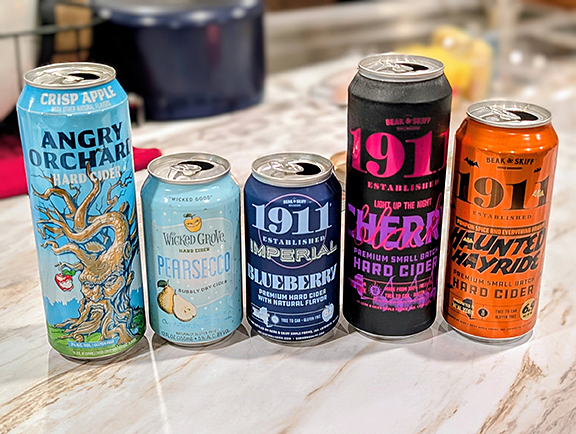
Craft hard cider continues to grow in popularity with so many different and delightful variations to try! Ciders are also naturally gluten-free, and therefore folks with specific allergies or food sensitivities have a golden opportunity to imbibe right alongside their beer-swigging friends. This fall, grab a couple of cool, crisp, hard ciders and treat yourself after an afternoon of apple-picking. Tis the season!
Cheers!