Cords. And the Virtual Experience
Recently, I gathered and organized some of the many cables scattered around my home and office. It was quite a chore, though one validation of a long-standing complaint became evident: more and more devices have opted for a USB-C data/charging cable as a single standard, making for fewer types of cords!
Since we live in a device-happy world, having the proper cords and cables is simply a necessity as basic as light and probably refrigeration to managing in the modern era.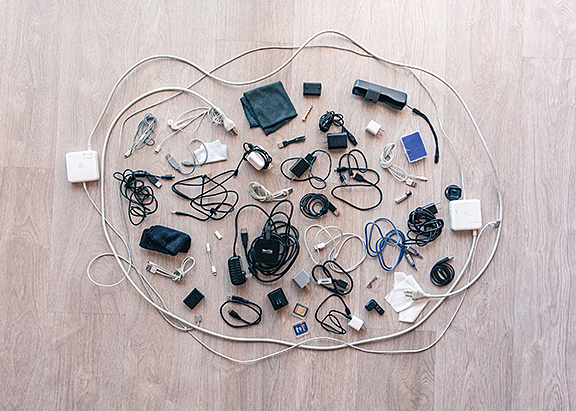
Computer cords/cables send data, carry video and sound, supply power/charge our phones, computers, tablets, screens and WiFi/Internet. Each has a job, and most of us will require some or all of them most of the time. It’s especially frustrating when we can’t charge our phones or tablets or even laptops because we don’t have the right connection close to hand.
More and more, we’ll also rely on chargers for ear buds, or if we’re old school we’ll want to plug a headset into our laptop or tablet or even our phones.
Here’s a quick primer on cord types you’ll probably have need of at some point or another:
Power and Display Cables:
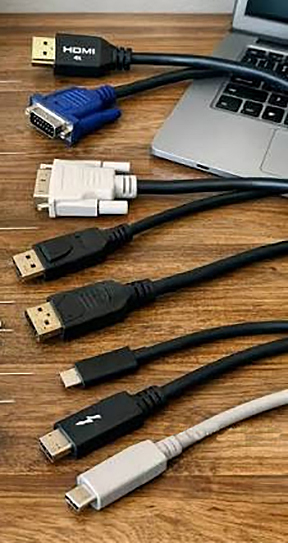
- Power Cord: Plugs your computer or monitor into the wall socket.
- HDMI: Carries high-quality video and sound to monitors or TVs.
- DisplayPort: Connects desktop computers to high-resolution computer screens.
- VGA / DVI: Older types of video plugs for screens and projectors.
- Data and Device Cords
- USB-A: Standard rectangular plug for mice, keyboards, and flash drives.
- USB-C: Small, fast, modern oval plug used to charge laptops and transfer data.
- USB-B: Square-ish plug often used for printers and scanners.
- USB-Lightning: (the old iPhone style)
- Audio (3.5mm): Round plug for headphones, speakers, and mics.
Keep in mind that your data/device cords will come in varieties such as USB-USB, USB-C, USB-micro USB, and other combinations depending on what you plan to connect to what. And the cords will come in varying lengths from 3 inches to several feet. And the plug/charger end can come in a variety of shapes and sizes and number of inputs for the cords. The cord material can be soft plastic casing or braided, among other choices, and you can make use of a variety of male-male, male-female, female-female cables and adapters to complicate, or simplify your connection.
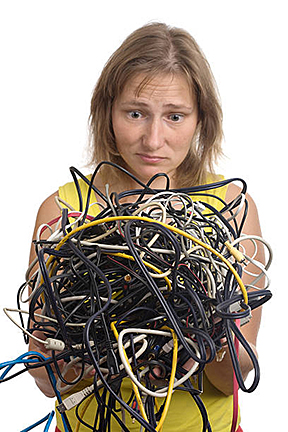
And of course the charging plugs are available in different wattage and configurations to challenge you even further. A listing on Amazon for one available charger block is a good example: 40-60W USB C Charger Block for iPhone 17 Fast Charging, 3Pack USB Type C Charger Blocks Max Output 60W Fast Charging Compatible with iPhone 17/17 Air/16/15 Pro/ProMax/14/13/12iPad Pro/Air/Mini/AirPods.
While the world of connecting and charging remains more or less device specific, a friend and I recently agreed that iPhone switching to a C charging cord was at least one win for simplification!
One more thing: I recently had a chance to try out a VR game. I had been watching a young boy play, and was laughing and recording him and his wild movements and gestures using dramatic movie music to underscore what seemed to be over-the-top action as he stared into his goggles and moved his arms for no discernable reason.
Then I tried it.
He was merciful in not recording whatever kind of movements I probably made, but what I can tell you is this: other than not actually having to walk, you are suddenly immersed in a world that has shape, size, “space,” things coming at you and retreating from you, small holes, sudden dips. I found myself ducking, yelling, looking around as if moving my head made a difference, and talking to no-one as I reacted to what the game was showing me.
People have reported dizziness and nausea, and even pro players can get worn out from an hour or more of game play as they step, swing their arms, load their weapons, shift their bodies and focus on the gameplay.
Most of all, I was shocked at how “in” the game you actually feel, soon forgetting the “real” world around you as you focus more and more on the world of the game. And I’m sure as you learn the rules and become adept, your focus will also shift to actually winning!